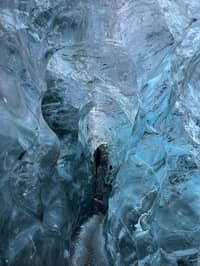
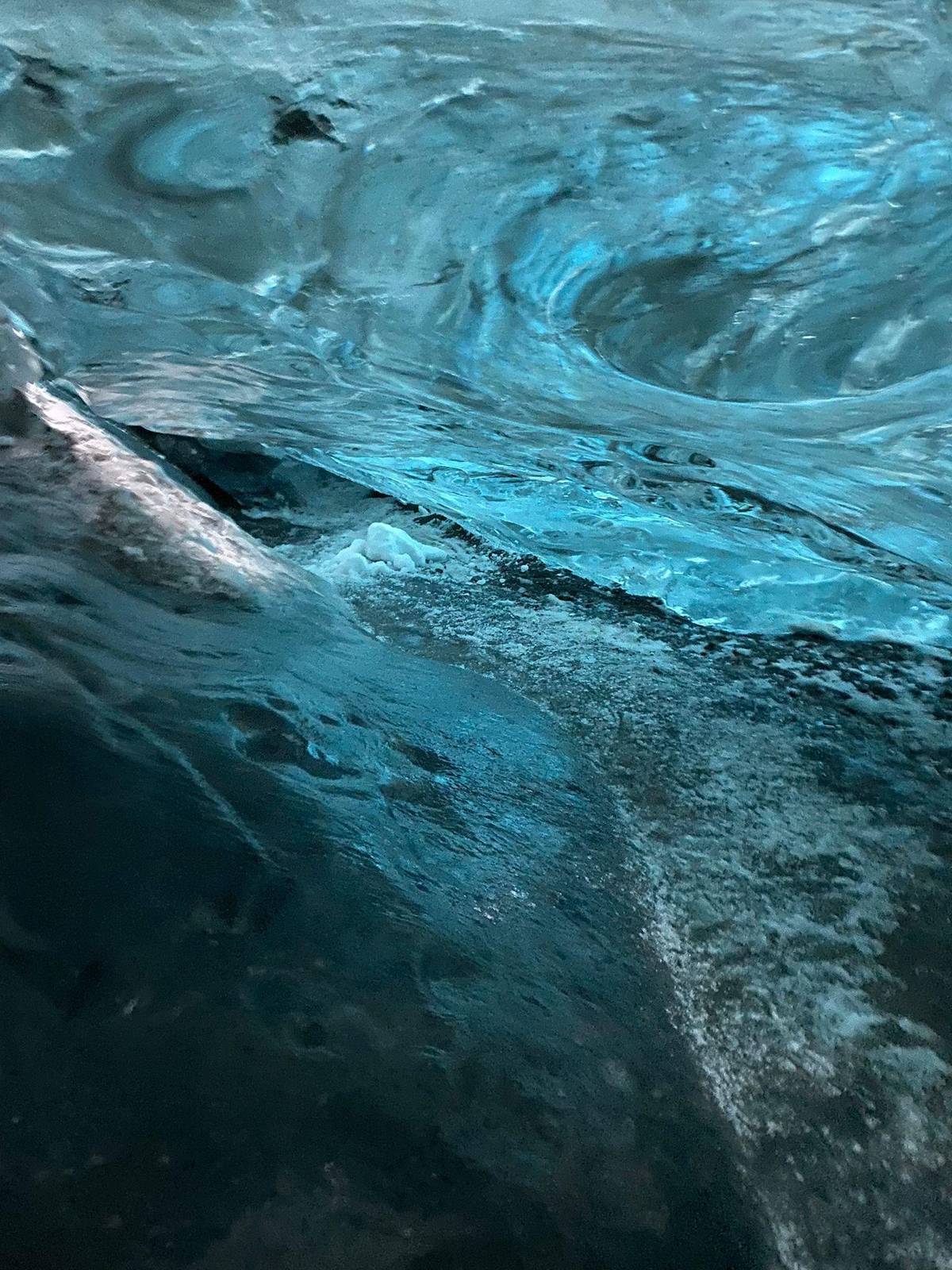
 Long light path
Blue
Dense glacier ice
- Red light gone after
- About 2 m
- Violet survives
- About 200 m
- Source
- Warren 2019
Guides
Language
EnglishCurrency
US dollar · $On GetYourGuide you see prices in this currency.
Guide · The science
What is blue ice? It is ordinary glacier ice, dense enough and deep enough to filter out red light. Here is the physics in plain words, and what it means for the color you will see in a cave.
Editorial team, blue-ice-cave-iceland.comUpdated October 25, 20267 minutes to read30 sources
The short answer
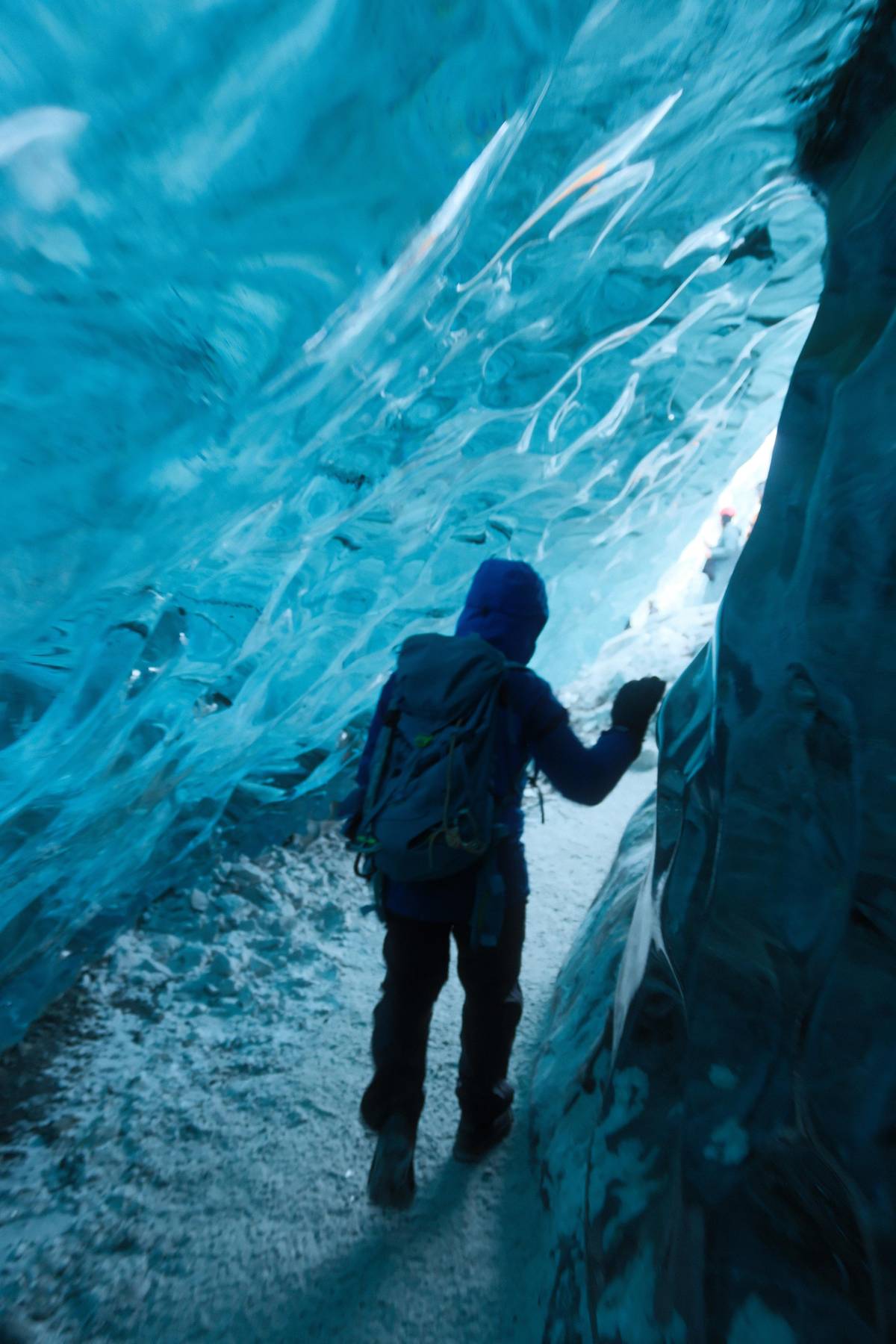
So, what is blue ice? It is glacier ice seen through enough thickness that its color shows. The US Geological Survey explains that glacier ice is blue because ice absorbs the red, long-wavelength part of white light, while the blue, short-wavelength light is transmitted and scattered.1 Nothing is painted onto the ice; the color is a property of frozen water itself, revealed when light travels far enough through it.
Other public sources say the same in their own words. Vatnajökull National Park writes that ice is blue because it reflects blue light and absorbs the red and yellow part of the spectrum.6 NASA Earthdata puts it more bluntly: the dense ice of a glacier absorbs every other color of the spectrum except blue, and sometimes the ice looks almost turquoise.78
Warren, in a 2019 review of the optics of ice and snow, describes ice simply as a weak filter for red light.9 That one phrase explains most of what you see in a glacier cave: thin ice looks clear, thick ice looks blue, and the deepest walls glow the most intense shade of it.
From snow to blue ice
Each winter
New layers bury and compress the snow below.10
First years
Compression makes the snow recrystallize into grains like sugar.10
About a year
About two-thirds as dense as water.11
About 830 kg per cubic meter
The air is sealed into bubbles.4
Deeper and older
Bubbles shrink under pressure and dissolve into the ice.12
Centuries
Very old glacier ice can grow crystals the size of an adult fist.13
If ice is blue, why is an ice cube clear? Because the effect is weak and needs distance. The USGS states that the longer the path light travels in ice, the more blue the ice appears.2 Warren gives the absorption length of ice as approximately 2 m for red light at 700 nm, but approximately 200 m for violet light at 400 nm.14
In other words, red light is gone after a couple of meters of ice while blue light keeps going. Warren adds that photons of every visible color survive and are reflected or transmitted unless the path through ice is long enough to absorb the red.15 An ice cube is far too small for that; a cave wall lit from outside through meters of glacier is not.
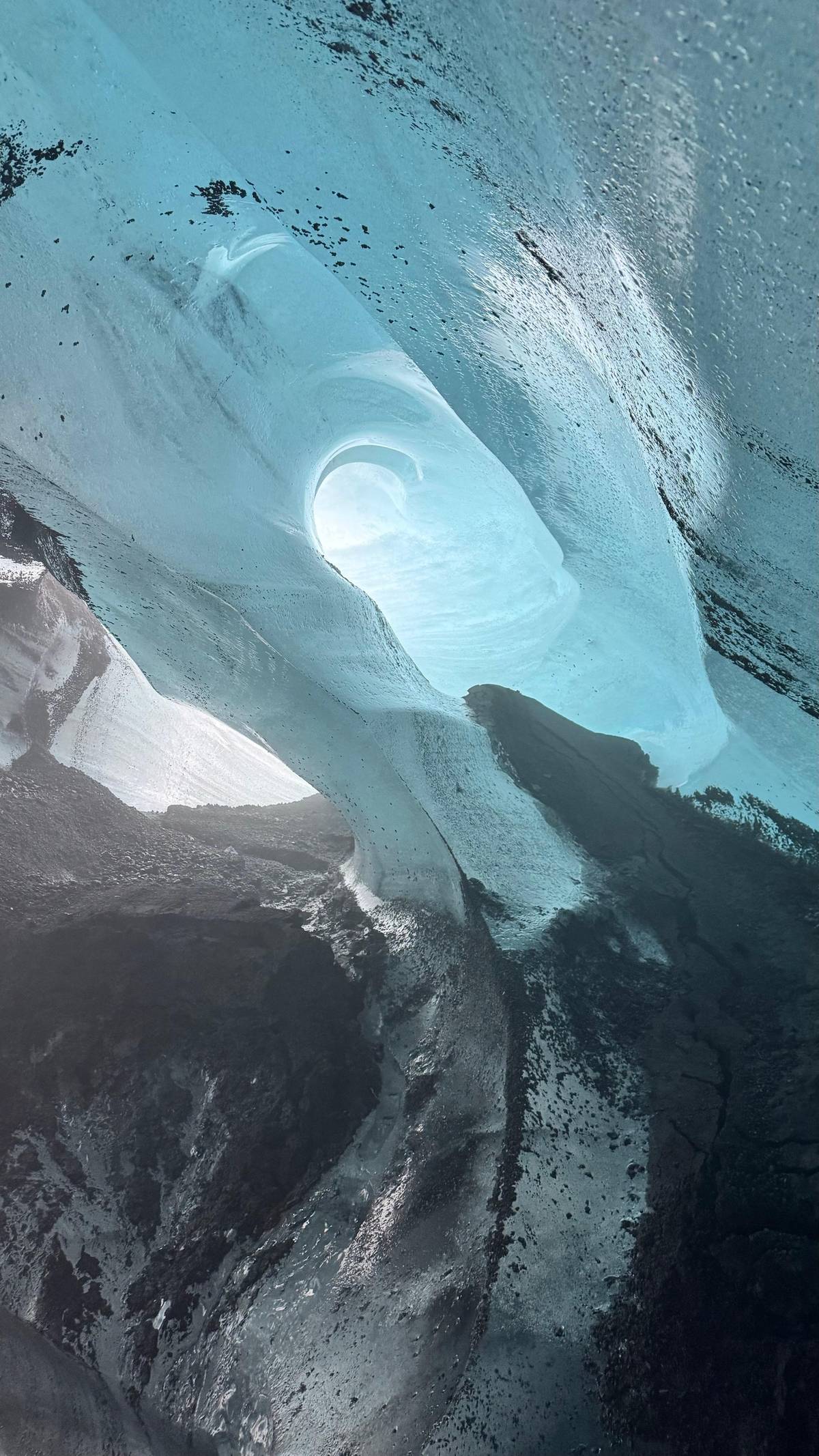
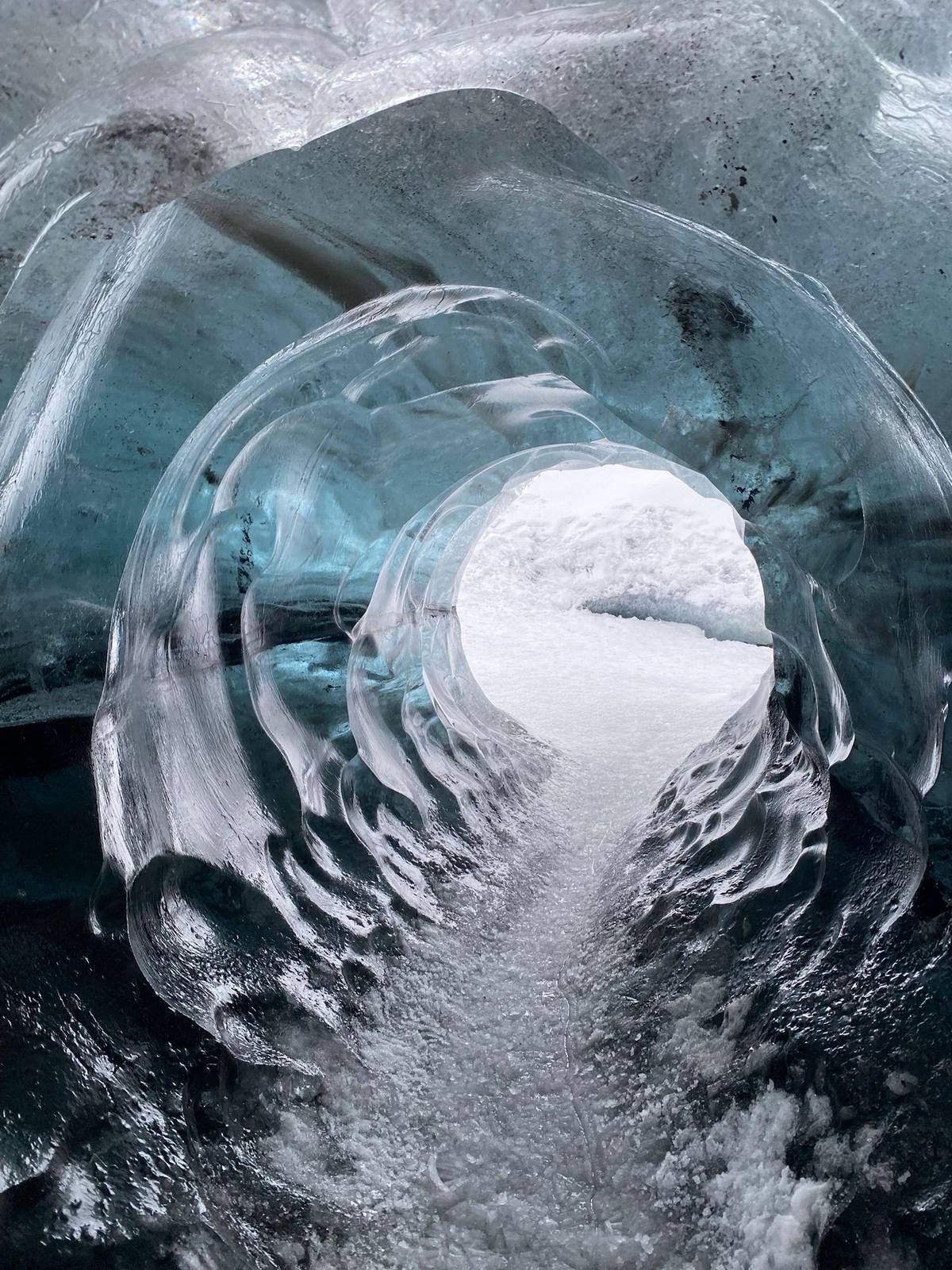
This is what causes blue ice to look so different from one cave to the next, and even across a single cave. Where daylight has to pass through a thick ceiling, the light that reaches you is strongly blue. Near the entrance, or where the roof is thin, more light arrives unfiltered and the ice looks paler and greyer.
Colors in the ice
| Color | What you see | Why |
|---|---|---|
| Deep blue | Thick, dense glacier ice | Red light is absorbed over a long path |
| Pale or clear | Thin ice near light | The path is too short to remove red |
| White | Snow or bubbly ice | Light escapes before it travels far |
| Black | Bands in the walls | Volcanic ash trapped in the glacier |
| Green | Occasional tints | In marine ice, organic matter or iron oxides |
Based on the USGS, Warren (2019), NSIDC and Ice Explorers; what you see on a given day also depends on the weather and the light.12351718
The colors
Long light pathDense glacier ice
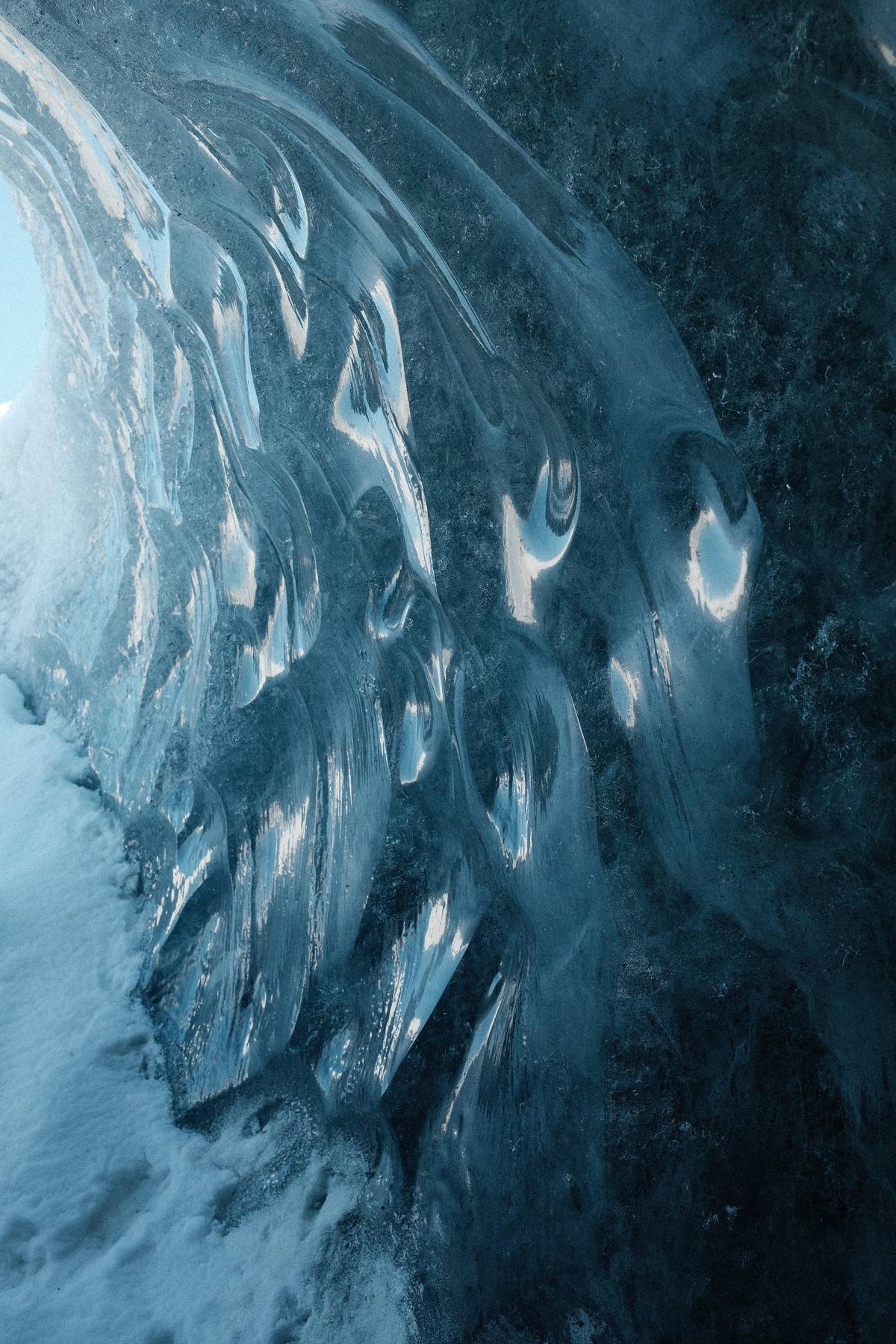 Short light path
Snow and firn
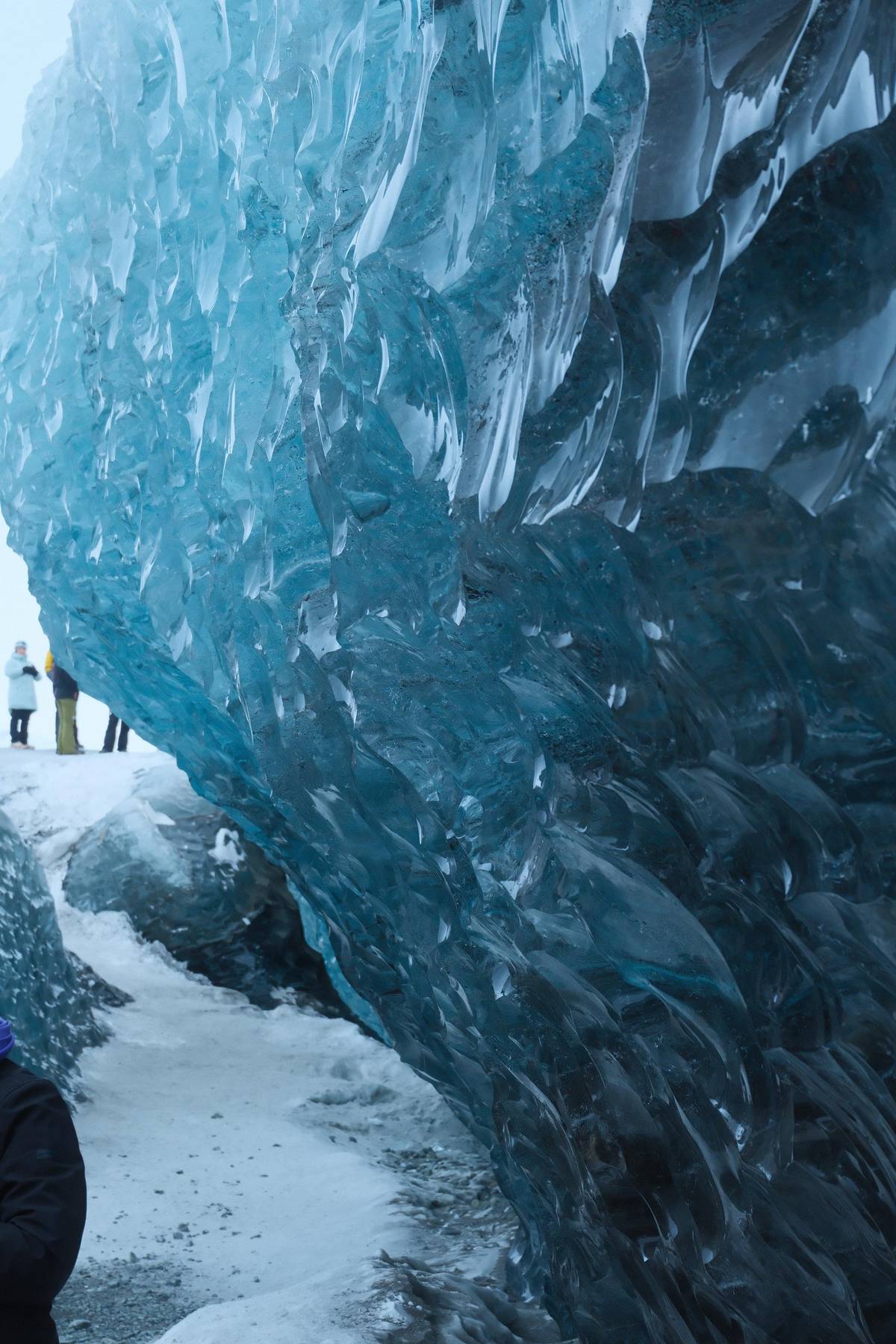 Buried eruptions
Volcanic ash
What to look for
Use the science to see more in the cave
The longer the light path through ice, the bluer it appears.2
Colors vary with weather, snow cover and natural light.
Ash trapped by the glacier shows black in the cave.5
Air is sealed into bubbles as firn becomes glacier ice.4
In snow, light escapes after only about 20 cm of ice.3
Glacier ice is blue because the red (long wavelengths) part of white light is absorbed by ice and the blue (short wavelengths) light is transmitted and scattered.
Snow is made of the same ice, so why is a snowfield white? Warren's answer lies in the size of the grains. In snow the grain radii are typically around 100 micrometers, so even after 1000 refraction events a photon re-emerges having passed through only 20 cm of ice, far too little to lose its red.3
Set that against the absorption length of about 2 m for red light and the answer is plain: 20 cm of ice is nowhere near enough to filter out the red.314 Warren also notes that ice absorbs visible light so weakly that, in natural snow, the sunlight that is absorbed is dominated by tiny amounts of impurities such as dust and soot.19
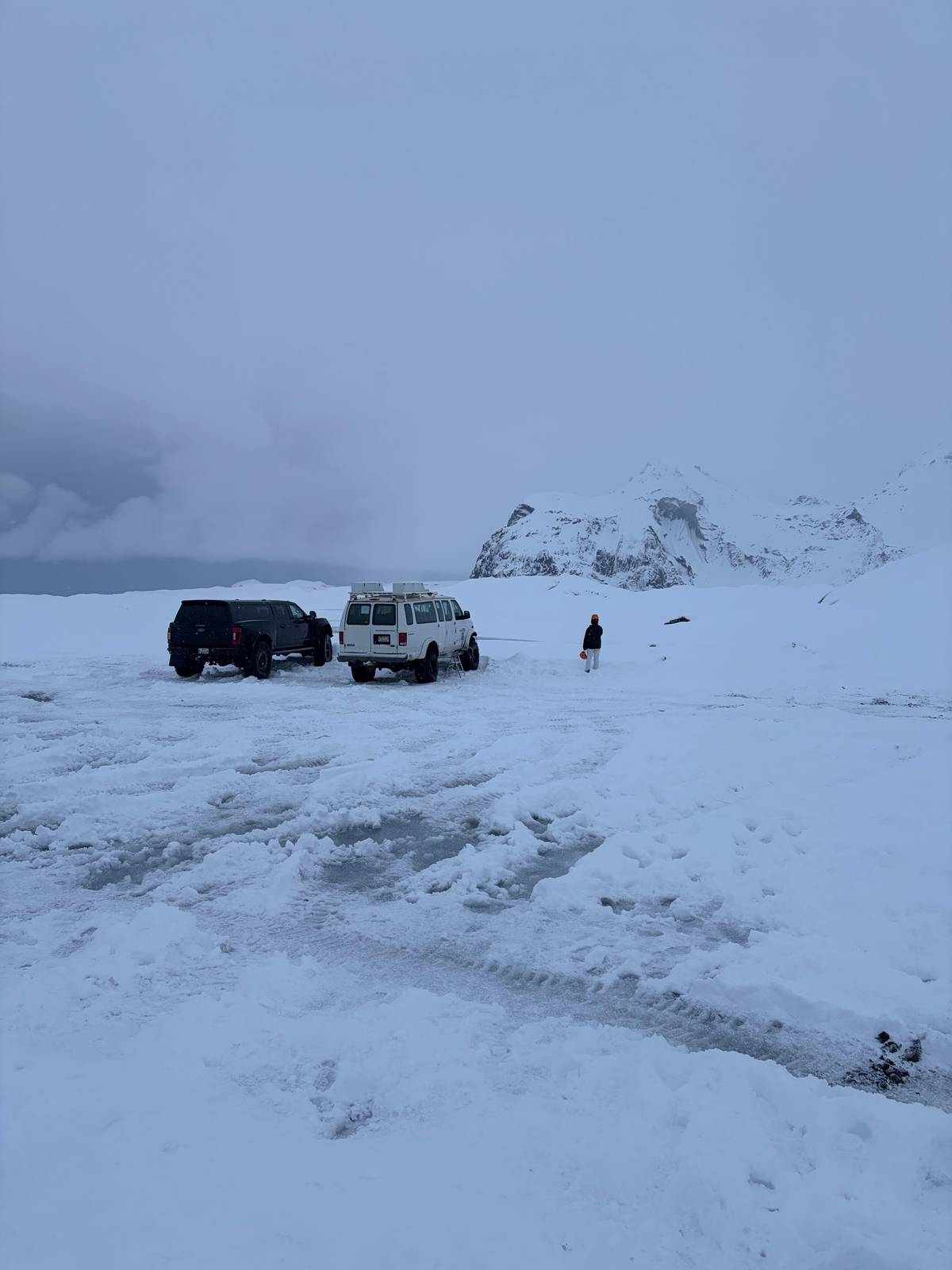
That is why the fresh snow lying in a cave entrance looks brilliant white right next to deep blue walls. Ice Explorers describes colors on its tours that run from bright blue through emerald green to black, and the snow is the white that frames them all.18
Checklist
Video
No video data loads before you press play.
Blue ice starts as snow. NSIDC explains that each year new layers of snow bury and compress the old ones, forcing the snow to recrystallize, first into grains about the size and shape of sugar.10 After about a year the snow becomes firn, an intermediate state between snow and glacier ice, about two-thirds as dense as water.11
Warren puts numbers on the squeeze. Snow with a density typically of 300-400 kg per cubic meter is compressed under its own weight into firn of 550-830 kg per cubic meter, and when the density reaches approximately 830, the air is sealed off into bubbles and the material is called glacier ice.164 Deeper still, the bubbles shrink under pressure and eventually dissolve into the ice.12
The whole process is slow. NSIDC says that over time the crystals become so compressed that any air pockets between them are very tiny, that crystals in very old glacier ice can reach the size of an adult fist, and that for most glaciers the process takes more than a century.13 Warren notes that ice develops a noticeable blue in glacier crevasses and icebergs, especially marine ice with its lack of bubbles.20
Iceland adds a third color. NSIDC describes the light in a cave at Breiðamerkurjökull as moving between the blue of pure ice, the white of fresh snow and the black of volcanic ash trapped by the glacier.5 NASA notes that some icebergs in Jökulsárlón are electric blue with black streaks of ash from past eruptions.21
Those streaks are buried history. Researchers have detected tephra layers of known age inside the Mýrdalsjökull and Vatnajökull ice caps, and a study of Vatnajökull's outlet glaciers, an ice core and written records built a volcanic record reaching back to A.D. 1200.2223 In the summer of 2010 the Eyjafjallajökull eruption spread a thin layer of tephra onto almost all Icelandic glaciers.24
Ash on the surface also speeds up melting. A 2020 study by Aðalgeirsdóttir and colleagues says tephra and dust on glacier surfaces enhance melt by lowering the albedo.25 An experiment on Vatnajökull in 2015 found that thin ash layers, about 1.5 mm and 8.5 mm thick, substantially increased how fast the snow surface lowered, while a thick cover had some insulating effect.26
You do not need a cave to see blue ice in Iceland. Warren notes that ice develops a noticeable blue color in glacier crevasses and in icebergs.20 At Jökulsárlón, NASA reports that a few icebergs are thought to be made of ice more than 1,000 years old, and that while many are white, some are electric blue.21
A walk on a glacier shows the same physics from the outside. On the lagoon side of Vatnajökull, Ice Explorers runs a summer glacier walk from May to September, when its cave tours are off, and the crevasses and moulins on such walks open windows into the ice.27 Look into any deep crack and the blue appears exactly where the ice is thickest.
The man-made tunnel in Langjökull offers another view. Its operator gives 25 meters of ice above the tunnel and 200 meters below it.28 It is a quieter, lit corridor rather than a cave shaped by water, but its walls are the same old snow turned to glacier ice.
Because the color depends on thickness, light and what lies in the ice, it changes with every cave and every day. Lagoon tour listings say plainly that the ice in a cave can look bluer or paler as weather, snow cover and daylight change. A cave under fresh snow on a grey morning will look darker than the same cave on a bright day with thin cover.
The caves themselves also change. Glacier caves form within the ice and are often carved out by water running through or under it, NSIDC explains, and Ice Explorers says its caves change from season to season and even within a season.2930 Each winter's cave sits in different ice, with its own thickness, bubbles and ash bands.
So enjoy the color you get rather than chasing an old photograph. Look at how the blue deepens away from the entrance, at the white of snow drifted inside, at the black lines of ash, and at the clear, glassy ice where the cave wall is thin. All of it is the same frozen water, telling you how much glacier stands between you and the sky.
This winter's cave
Pick a date between October and April and see the ice as it is this season.
It absorbs red light. The USGS explains that ice absorbs the red part of white light, while blue is transmitted and scattered.1
It is too thin. The absorption length of ice for red light is approximately 2 m, so the effect needs a long path.14
Light leaves it too quickly. In snow, light re-emerges after passing through only about 20 cm of ice.3
Volcanic ash. NSIDC describes black volcanic ash trapped by the glacier in a Breiðamerkurjökull cave.5
Years to centuries. Snow turns into firn after about a year, and for most glaciers full glacier ice takes more than a century.1113
Sometimes. Ice Explorers describes emerald green ice; in marine ice, organic matter or iron oxides can shift blue to green.1817
It depends on the day. Colors look more or less blue with weather, snow cover and natural light.
Sources